
For some time now, we have been bombarded with dire reports about the decline of bees and the consequences this has for humanity. Our very existence would actually depend on it, because: without bees, there is no pollination of fruits and vegetables, no pollination of crops that serve as animal feed, so animal food for humans is also at risk...
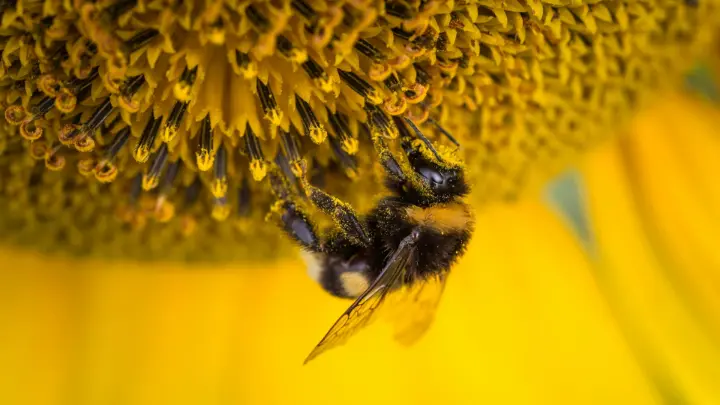
Why are bees so important for our world?
If you ask that question specifically about honey bees, then people are actually only focusing on the honey they produce. But if you look at it purely from a societal AND economic perspective, the main answer is still pollination; not only by honey bees, but also by solitary bees, bumblebees, and other flying insects.
Is there a difference between honey bees and wild bees?
Within the world of insects, we can limit ourselves to the flying insects for pollination, and the most well-known among them are bees, bumblebees, and wasps. Strictly speaking, bees and bumblebees belong to the same genus, while wasps belong to a different genus. Within that group of bees and bumblebees, we also make an 'artificial' distinction between solitary and social insects. Because honeybees can cooperate very well, they are of utmost importance for pollination when it comes to results, namely for the fertilisation of crops.
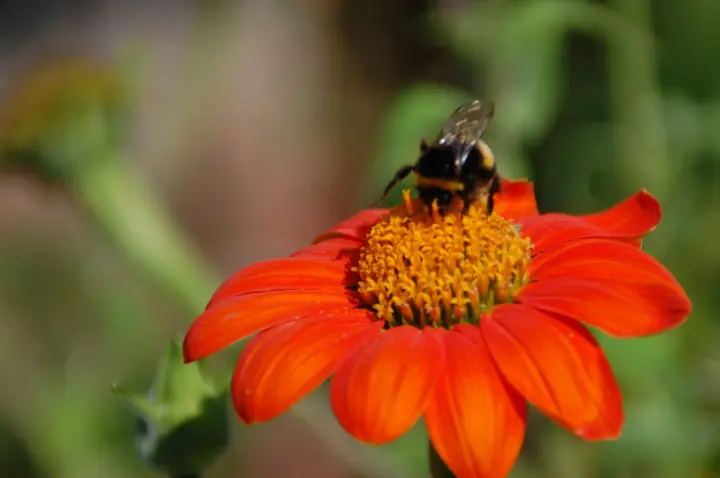
In a large oilseed rape field or in a big orchard, honeybees will first send out their scouts, after which the entire colony will be perfectly organised within the hour to optimally pollinate the blossoms of the oilseed rape (and of course, to collect honey). Solitary bees will also seek out that field and orchard, without having contact with neighbours, and thus will not be present in thousands. However, solitary bees are of invaluable importance for native plants, as some are even very 'species-specific', meaning that one bee species will pollinate a particular plant and no other. Solitary bees are quite content as long as their honey supply is sufficient for their reproduction, and honeybees are not interested in that; they only seek the 'big gain' from the 'mass production' that we offer them. Solitary bees are of the utmost importance for ecology in general, for the survival of nature as a whole. Bumblebees are active on wild plants, such as balm, comfrey, but also on tomatoes, courgettes, and pumpkins. Generally, they are of less economic importance, not least because they are so heavy and cannot always access the nectar.
Wasps tell a different story: at the beginning of the season, the larvae are raised on animal proteins, from caterpillars, bee larvae, etc., and the sweet secretion of those wasp larvae serves as food for the older wasps; they will therefore not collect nectar from flowers. At the end of the season, there are no more wasp larvae, and they seek their 'sweetness' from alternative sources, including some nectar from flowers, and especially in obvious sweetness left behind by humans... It is only during this period (August/September) that wasps can be hungry and sometimes aggressive. Bees, both honeybees and solitary bees, are NOT aggressive and will therefore never sting unless you step on them or trap them in some other way. Solitary wasps (sawflies, digger wasps, etc.) are also ecologically very important, as they are species-specific and often reliant on a particular type of plant.
What do bees look for in flowers?
Pollen, also known as pollen grains, contain a lot of proteins and are a source of essential nutrients for bees and many other insects. A sufficiently varied supply ensures that bees remain healthy.
Nectar is a source of energy for many insects to fly. Bees collect flower nectar and process it into honey: they enrich that nectar with enzymes, etc., extract the excess water from it, and store the resulting honey in the comb, which then serves as food for the larvae and also for the bees.
What are the biggest threats to bees?
The biggest problem for bees and also for other insects is the total degeneration of the species, both of honeybees and wild bees. What are the causes of this?
- of advanced breeding/inbreeding of bee breeds by humans, where more attention was paid to productivity (producing as much honey as possible), at the expense of the health of the breed,
- the decline of the food supply; for example, maize has a lot of pollen, but there are still questions about the manipulation and selection of maize seeds... and mono-cultures are not good for the bees anyway;
- valuable plant communities are disappearing due to urbanisation, the construction of roads,…
- the emergence of diseases and pests, which may have always been latent in the populations, but now, due to the slow degeneration and weakening of the race, break out, with very serious consequences; the most well-known is the Varroa mite, which has caused entire bee colonies to weaken and even die;
- Exotic plants are gaining popularity, and they are not always original plants from exotic places grown from seed, but often hybrids and extensively cultivated cultivars, from which insects can no longer derive anything. On the other hand, some imported exotics that are now seen everywhere in nature, and are often considered 'invasive', are not always the culprits they are portrayed to be: for example, Himalayan balsam is not native, but has proven to be very valuable for bees, as well as for bumblebees; the Acacia is also not native but is still a significant source of nectar, and there are many others...
- perhaps the most important cause is: the excessive use of pesticides, in agriculture, but also in gardens; we apparently cannot bring ourselves to completely ban the use of those neonicotinoids (Roundup & Co) even though the harmful effects have been sufficiently proven. Moreover, there is another severely underestimated consequence of excessive pesticide use: the bird population is also declining! Just think of all the insect-eaters that are poisoned by the caterpillars of the Box tree moth when they are killed by the 'classic' pesticides.
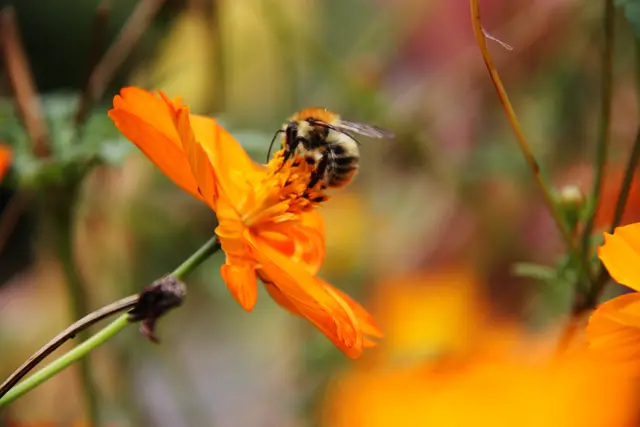
What can we do in our own garden to help the bees and ensure their survival?
- don't be too tidy: a lawn with clover provides an incredible amount of nectar for the bees; therefore, it is not necessary to combat those clovers, and other flowers in the lawn, with chemical agents;
- Weeds can be a great resource for bees and bumblebees: besides providing nesting opportunities for some, they gather a lot of pollen and nectar from flowering grasses and weeds. Apart from the troublesome bindweed, horsetail, and couch grass, you should let the 'weeds' have their way here and there in the garden;
various trees, shrubs and perennial plants (including bulbous plants!) can provide a food source for all bees and bumblebees;
TREES:
- There are more trees than thought that are fantastic nectar plants, for example Acer campestre, the Field Maple, which not only produces very good honey but also proves to be a very beautiful hedge plant; the well-known Lime, Tilia, and Gleditsia triacanthos, the false Christ thorn, are visited in spring by masses of bees; the latter also attracts whole groups of long-tailed tits in late summer, who are fond of the seeds. And there are many more trees, whether native or not, that are valuable in any garden;
SHRUBS:
- Buddleia, the butterfly bush, Corylus avellana, the hazel, Clematis, Hydrangea paniculata, Rosa rugosa, and many other shrubs are traditionally widely planted, attractive for the pollen and nectar they provide over a long season.
VAST PLANTS:
- The list of perennial plants that attract bees and bumblebees is endless: Aster, Astrantia, Bergenia, Campanula, Cirsium (thistle), Leucanthemum (daisy), Echinacea, Salvia, Nepeta, Sedum, and many others attract a great number of pollinating insects during their flowering period. Native and local plant material is the most suitable for insects and birds. However, cultivars or selections of, for example, perennials or annuals can also be valuable, provided that you allow as few hybrid species or in vitro cultivated plants as possible. Additionally, plants with very double and filled flowers are actually worthless: bees and bumblebees find it difficult to access nectar and pollen in the heart of the flower;
- Besides wild plants to provide pollinators with an ideal habitat, you can also, and not least for your own enjoyment, choose to sow or plant ANNUALS. After all, these are all plants that belong to the native flora in their country of origin. By annuals, we do not mean the brightly coloured, usually hybrid varieties of Busy Lizzies, Marigolds, Begonias, etc., which are abundantly found in garden centres in spring, but the annuals that you can grow yourself from seed. An additional benefit of flowering annuals: they provide the much-needed nectar/energy during certain periods of the year when there are fewer nutrients available (August, September, ...).
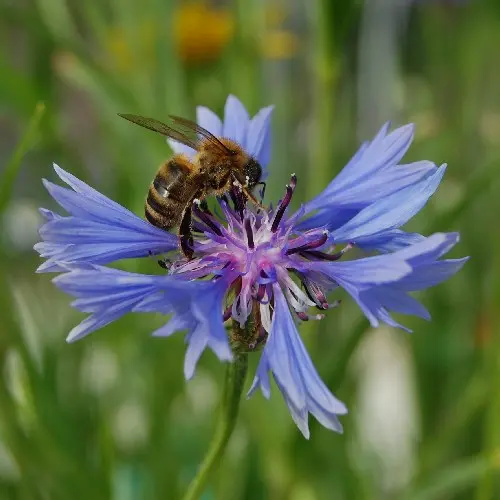
Almost all annuals belong in the list, but if it's difficult to choose, then just sow a wildflower meadow! Besides wildflower meadows with native plants, adapted to the soil and the situation in your garden, which are of course ideal for natural life, you can also opt for wildflower meadows with exotic plants. These are usually very prolific and self-seed well, but never too much. The buzzing of the thousands of bees at such a grand feast is the best reward for your efforts….
in our assortment
discover here which nectar-friendly flowers we offer